
HFMA RCC 2026: AI is the Multiplier, but the Process is the Solution

Post by
Seth Pfaltzgraff
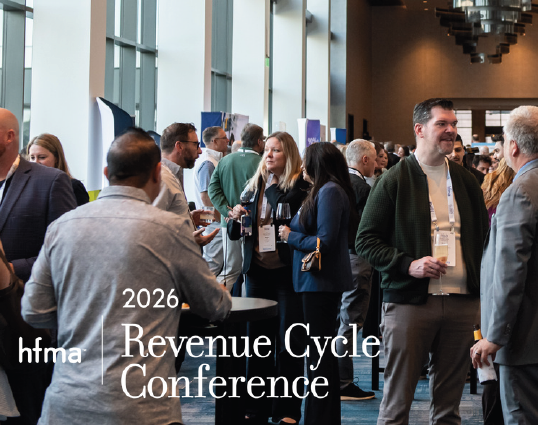
HFMA Revenue Cycle Conference 2026 had no shortage of AI conversation, but what stood out was not just the technology. It was how often speakers came back to the same idea: the system itself needs to change.
In my conversations with CFOs and RCM Directors, it became clear that we’ve reached a tipping point. Across sessions, whether it was operational leaders or futurists, the message was consistent: AI is powerful, but without structure around how work gets done, it just accelerates existing problems. But, if you apply a multiplier to a broken process, you just get a faster version of a broken process.
AI is not the solution by itself, it is the multiplier.
Here are four reflections from Dallas that stuck with me. But first, full disclosure: Macedon makes an Award-winning NSA Automation Software. Schedule a chat with me if you would like to know more.
Insight 1: Denials aren't a Back-End Problem; they are created upstream
One of the most impactful sessions I attended highlighted a hard truth: by the time a denial shows up, the mistake has already happened. You’re just deciding how to pay for it.
In this operational session, the presenter walked through a denial reduction effort that did not start in billing or appeals. It started with data validation and front-end workflows. As they pointed out, before they could even act, they had to answer a basic question. What is a denial versus a classification issue or a process breakdown
Once that baseline was clean, the focus shifted upstream. Patient access, intake, and documentation. Not just fixing errors but assigning ownership and building feedback loops across teams. That was the unlock, not a new tool or model.
My quick take: Denial reduction does not start in appeals. Reduction starts by using your win data to ensure the claim is "pre-vetted" before it ever leaves the building.
Insight 2: Navigating the "Battle of the Bots"
In the keynote, Christina Farr from Manatt Health made a point which really stuck with me: Healthcare has been inflationary for decades, and AI is not changing that yet. In fact, in some cases, it is doing the opposite.
She used ambient documentation as an example. It reduces physician burnout and improves documentation quality, but as she put it, AI can “always find more billing opportunities than a human being can at the end of the night.” More complete documentation leads to more accurate coding, and often higher reimbursement.
At the same time, she and Shawn Stack described what is starting to feel like a “battle of the bots.” Payers are now using AI to deny claims in fractions of a second. Providers are using AI to respond and appeal faster. Both sides are getting more efficient, but the system itself is not changing.
My quick take: Speed doesn't always mean better, but in a world where payers are using bots to deny, providers must use bots to respond. You don't need a better argument; you need a better engine.
Insight 3: The shift in how organizations operate
Jonathan Brill, an accomplished Business Futurist, framed AI less as a technology shift and more as an operating model shift, especially for how work gets distributed across teams.
His point was that most jobs are not going away, but tasks are. Referencing research from McKinsey, he noted that roughly 8% of tasks across the economy may be automated by 2030, and closer to 14% - 16% percent for white collar roles, or save the average worker about an hour a day. In the Revenue Cycle, I believe the opportunity of saved time is much bigger.
That is where AI creates opportunity. Not just doing the same work faster but enabling entirely new types of work. In revenue cycle, that could mean identifying denial risks before submission, simulating payer behavior, or dynamically adjusting workflows based on real time data. These ideas have been around for years, but they have been difficult to operationalize at scale.
AI does not just speed things up. It makes new things possible.
That being said, the work does not disappear. It changes shape. By automating 85% of repeatable disputes, we allow teams to focus their "insider knowledge" on the 15% of complex cases that actually move the needle on the bottom line.
My quick take: As Brill put it, the opportunity is not just efficiency. It allows your best people to stop being "processors" and start being "strategists."
Insight 4: The Front End is the New Front Line
We often forget that the Revenue Cycle is a major part of the patient experience. As Christina highlighted in the keynote, patients aren't leaving providers because of clinical care, they’re leaving because of a frustrating billing experience.
Her personal example hit home. A simple insurance update was missed, leading to multiple incorrect bills and a frustrating experience. That alone was enough to consider switching providers.
The front end is not just intake anymore. It is the front line of revenue.
My quick take: As highlighted in the keynote, the front end is where retention, experience, and revenue all intersect.
Bringing these insights together
The biggest takeaway for me from HFMA Revenue Cycle Conference 2026 was the gap between capability and execution. Most organizations have "pockets" of automation, but the work still dies in the handoffs between disconnected teams. AI can generate insights, automate tasks, and improve outputs, but the system around it still determines whether that value shows up.
The big change is a move towards Orchestration that unifies the different branches of business.
Not just automating steps but connecting the full lifecycle of work across patient access, clinical documentation, billing, and appeals. Creating a system where ownership is clear, decisions are tracked, and AI outputs actually feed into the next step.
Revenue cycle is not a set of tasks; it is a system. AI is accelerating revenue cycle, but it is not fixing the overall system on its own. As Shawn Stack pointed out, this is quickly becoming one of the most invested and competitive areas in healthcare.
In that sense, the message is clear: successful organizations will not just adopt AI. Instead, they will rethink how work operates, how decisions are made, and how teams perform together.
Want to continue the discussion? Schedule a chat with Seth.