
Reclaiming RCM Control with 5 Operational Benchmarks from Leading Health Systems

Post by
Kenny Rosenberg
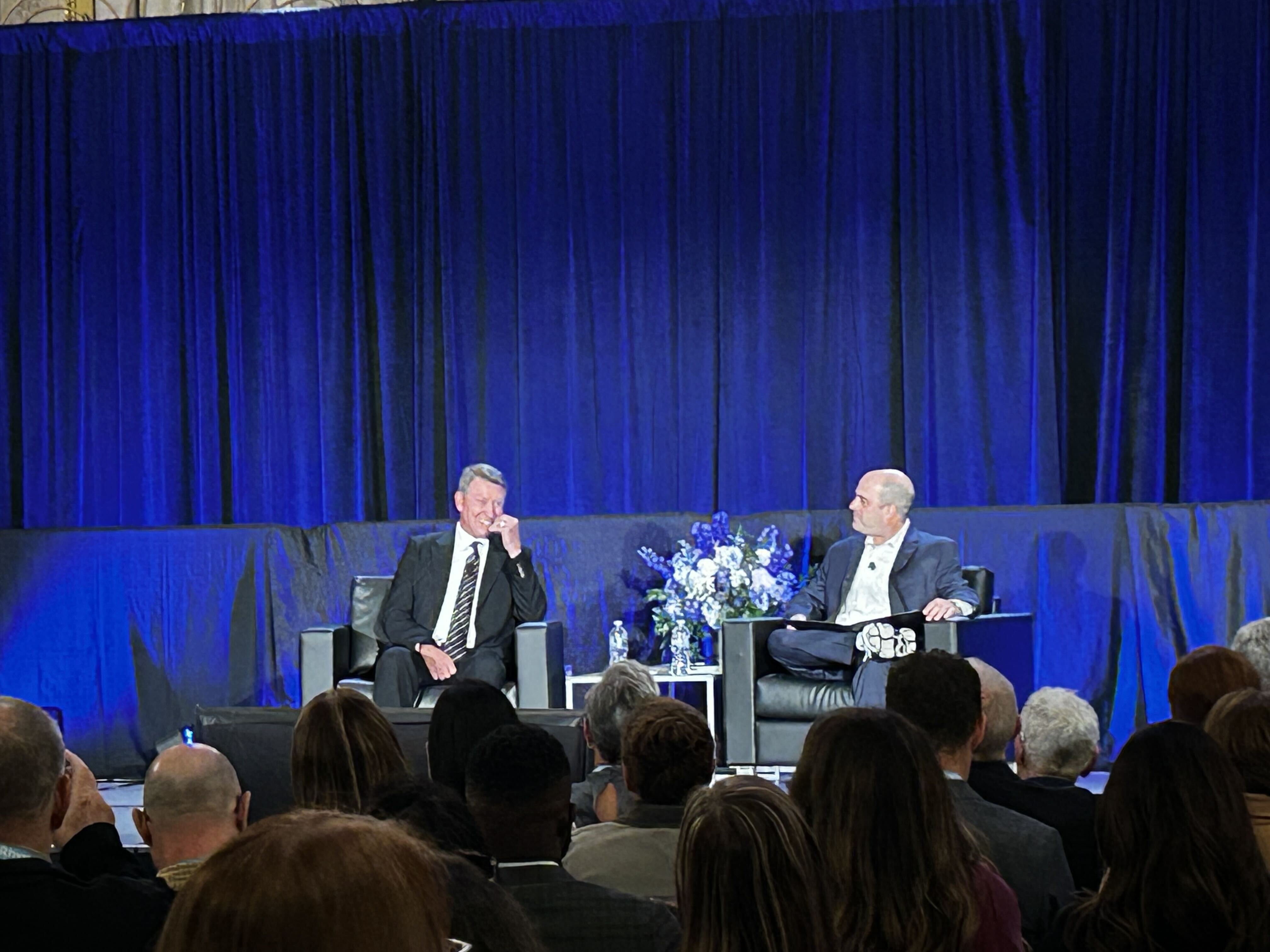
Centralizing revenue cycle operations and building automated back-office workflows—rather than buying standalone point solutions—is driving the largest measurable returns for health systems today. At Becker’s 11th Annual Health IT + Revenue Cycle Conference, RCM executives from Cleveland Clinic, Northwestern, and Ochsner shared hard performance data on how restructuring internal processes enabled their biggest financial wins.
Here are 5 primary benchmarks shaping RCM strategy this year:
1. Technology Alone Produced Zero Wins
In a panel featuring three chief revenue officers, each was asked to name their single biggest recent win. Every CRO described an organizational restructure that a consolidated system finally made possible, not technology.
- Cleveland Clinic: Ahmad Kalani shared how repositioning physician advisors out of siloed utilization management into a front-to-back bridge spanning denials, prior authorization, and contracting yielded massive returns, primarily because denial data was routed directly to clinicians.
- Carle Health: Aaron Klein detailed how moving from a regional to a functional back-end restructure dropped their denial write-off rate to roughly 2.5%. Consolidating systems enabled the shift, but aligning team culture was the real work.
- NYC Health + Hospitals: Margie Carlin noted that a centralization proposal lifted their net collection rate by 5% in year one ($50M value). That proposal was only viable because an Epic implementation eight years earlier gave the health system its first unified view of itself.
Conversely, an AI governance panel highlighted attendees who couldn't name the AI tools their health systems owned. The overall lesson? Technology bought without organizational realignment behind it produced no measurable return.
2. The Outsourcing Dilemma: Trade-Offs in Speed vs. Control
For small and rural health systems, there is a common assumption that advanced automation and in-house RCM are mutually exclusive, leading many to outsource. Panelists (unprompted) listed the unexpected friction that often follows:
- Front-End Denials: Shannon Cameron from Harvard Medical Faculty Physicians pointed out that front-end denials remain unfixable when patient access staff aren't your employees. In her organization's case, 65% of denials stemmed from registration errors before the operational fix.
- Vendor Capability Gaps: Panelists cited instances where billing vendors lost core coding teams with no contractual obligation to remedy the gap, while audit and vendor management overhead ate up projected savings due to state-versus-national rule drift.
- Where Outsourcing Worked: Trish Lündberg from Weston County Health Services noted that outsourcing did deliver on speed, cutting their claims cycle from 7–8 days down to 3. From my experience, automation also delivers on this speed without losing the value of control.
The reality is that automation for in-house RCM is accessible for even small and rural health systems; this is what we do.
3. Reframing the No Surprise Act as Payer Contract Leverage
Rather than treating the No Surprises Act (NSA) merely as a claim-level billing chore, forward-thinking health systems are reframing IDR automation as strategic leverage during payer contract negotiations.
- Ochsner Health: Andre highlighted how having the automated infrastructure to confidently go out-of-network creates genuine negotiating leverage when payers demand aggressive rate cuts.
- Denial Adjudication Terms: Panelists emphasized using state and federal dispute mechanisms to enforce physician re-adjudication terms in contracts, countering automated payer denial algorithms.
- Mid-Sized & Rural Health Systems: Organizations like Meadville (where Rene Suntay requested automated variance detection tools) and Weston County face concentrated out-of-network volume without the in-house headcount to track claim variances manually.
4. Epic is Both the Moat and the Clock
Health systems are increasingly "Epic-first" by written policy, deliberately choosing native functionality to reduce IT lift and maintain core vendor discipline.
- Budget Discipline: One safety-net hospital reported maintaining an IT budget at 2.4% of revenue against a 4.2% industry benchmark through strict core-vendor discipline over 29 years.
- Co-Building Models: Sandy Lute from Cottage Health emphasized a desire for co-building models that convert domain-expert RCM staff into builders who know the domain and own the final outcome.
- Usability Rot vs. Roadmaps: While Epic builds out roadmap features like medical necessity appeal modules showing 20–40% faster processing at pilot sites like Northwestern and Ochsner, hallway discussions focused on current usability friction: hidden work queues, manual filtering, and teams losing revenue because they cannot locate key reports.
In our experience, providing ease of use and workflow around Epic creates a lot of value and time savings.
5. The Back Office Delivers Hard Numbers through Automation
While vendor adoption and industry attention lean heavily toward patient-facing AI, hard ROI numbers at the conference came almost exclusively from back-office automation.
- Northwestern Medicine: Atek Pandya shared how a team of 3 people created 30 automations handling 400,000 items annually using RPA and Power Automate, creating the equivalent to roughly 24 FTEs of work and $1M in savings.
- Ochsner Health: Andre highlighted absorbing ~20 FTEs against 30% volume growth over five years in prior authorization, auto-generating 98% of estimates.
- Texas Health: Amy Cappuccio noted collections increased nearly 100% versus their prior partner after implementing an agentic financial call agent.
When evaluating automation, panel consensus advised against promising FTE cuts. Instead, promise time back and redeployment to complex exceptions, and enforce mandatory usage once deployed.
Staffing Constraints Make Human-in-the-Loop Essential
With experienced RCM staff scarce, highly remote, and actively recruited by payers (who are hiring UM nurses directly out of rural settings), tools must enable less experienced staff to perform expert-level work.
Aaron Klein noted Carle Health manages 350 back-end FTEs across 30 states with ~30 open roles at any given time, while Karen Brown and others cited patient access as a primary turnover point. On the AI governance panel, leaders emphasized that agentic workflows require a named executive owner, steering committee review, and continuous monitoring. This elevates human-in-the-loop design to a governance requirement.
This all culminates to: technology delivers results only when paired with process ownership. I completely agree. Health systems that reorganize around their tools, enforce governance, and maintain visibility over their workflows are the ones successfully bending the revenue cycle cost curve
Want to continue the discussion? Let's Talk